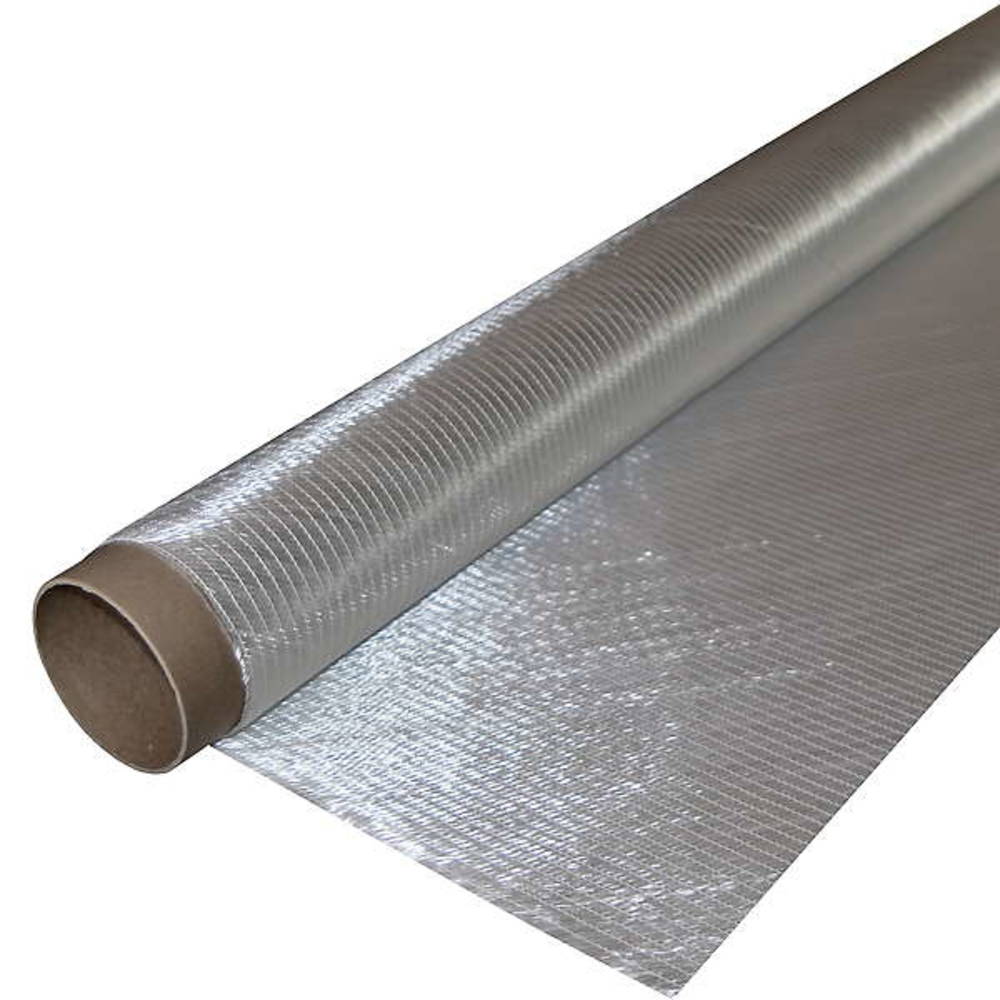
Glass non-crimp fabric 440 g/m² (biaxial, ± 45°), width 127 cm
USA: width 50", weight 13 oz/yd²
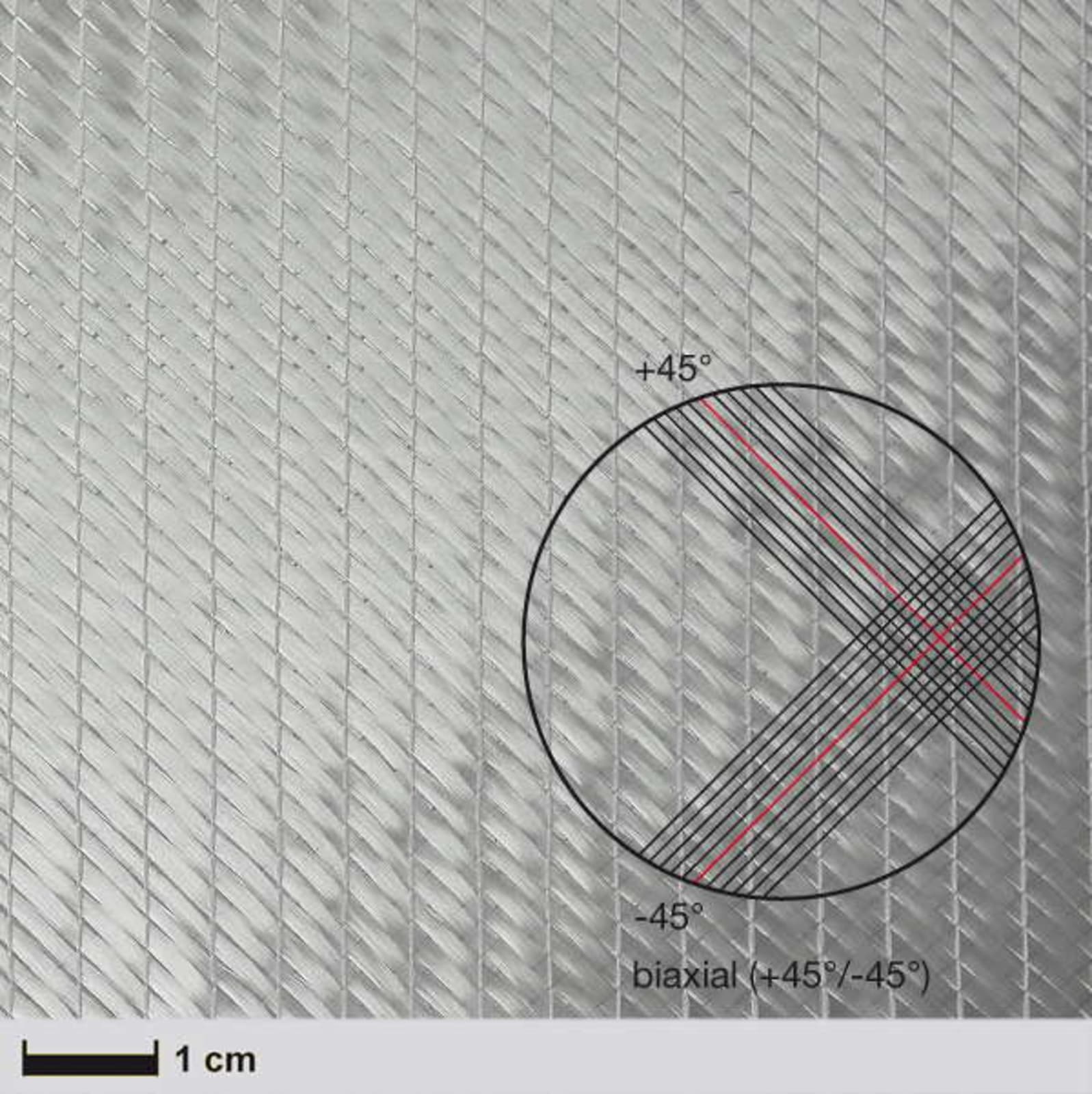
This biaxial glass reinforcement is manufactured from E-glass fibres with a fibre architecture almost entirely oriented at ±45°. The two primary load-bearing layers provide excellent resistance to shear and torsional loads, while lightweight 0° and 90° stabilising fibres maintain the integrity of the reinforcement during processing. With an areal weight of 440 g/m², this material is particularly suitable for highly loaded composite laminates used in lightweight engineering applications.
Detailed Description
This biaxial glass reinforcement is manufactured from high-quality E-glass fibres with a silane finish. The primary load-bearing fibre layers are oriented at +45° and -45° and are held together by a lightweight polyester stitching yarn. Additional 0° and 90° stabilising fibres maintain the stability of the reinforcement during handling and processing and contribute only minimally to the overall areal weight.
With almost the entire fibre content concentrated in the two ±45° layers, this reinforcement is particularly suitable for components subjected primarily to shear and torsional loads. Unlike conventional woven fabrics, the fibres are laid almost perfectly straight rather than interlaced. This minimises fibre crimp and allows the mechanical properties of the glass fibres to be utilised more efficiently within the laminate.
Despite its relatively high areal weight of 440 g/m², the stitched construction provides excellent drapeability, allowing the material to conform well to radii and complex mould geometries. It is therefore suitable for both large structural components and technically demanding composite parts.
Advantages in Use
High Fibre Content in the ±45° Direction
With a total of 434 g/m² concentrated in the two ±45° load-bearing layers, almost the entire fibre content is aligned in the direction most effective for resisting shear and torsional stresses. This makes the reinforcement particularly suitable for torsionally loaded composite structures.
Minimal Fibre Crimp
Because the fibres are stitched rather than woven, fibre crimp is kept to a minimum. This enables the mechanical properties of the glass fibres to be utilised more efficiently than with comparable woven fabrics.
Excellent Drapeability
The non-crimp construction conforms easily to curved surfaces and complex mould geometries, simplifying laminate lay-up and supporting the production of uniform, high-quality composite parts.
Stable Handling During Processing
The lightweight 0° and 90° stabilising fibres maintain the integrity of the reinforcement during cutting, positioning and lamination without significantly influencing the performance of the primary ±45° load-bearing layers.
Typical Applications
- Boat and yacht construction
- Ultralight aircraft construction
- Wind turbine rotor blades
- Torsion-resistant structural components
- Composite tubes and profiles
- Automotive engineering and motorsport
- Sporting goods
- General GRP and CFRP lightweight structures
Processing
This reinforcement is suitable for hand lay-up, vacuum infusion, RTM and other common composite manufacturing processes. The open stitched construction promotes efficient resin impregnation and reliable air release throughout the laminate.
Compatible with epoxy, polyester and vinyl ester resin systems.
Technical Data
| Fibre | 100% E-glass |
| Finish | Silane |
| Areal Weight | 440 g/m² ± 5% |
| Stitching Yarn | ≤ 10 g/m² Polyester |
| Width | 127 cm |
Construction
| Layer | Orientation | Areal Weight | Tex |
| 1st Layer | −45° | 217 g/m² | 300 |
| 2nd Layer | 0° | 3 g/m² | 68 |
| 3rd Layer | 90° | 4 g/m² | 68 |
| 4th Layer | +45° | 217 g/m² | 300 |
Calculated Laminate Properties
(Hand Lay-up, 35% Fibre Volume Content)
| Resin Consumption | 361 g/m² |
| Laminate Thickness | 0.480 mm |
| Laminate Weight | 801 g/m² |
Technical Notes
The structural load is carried almost entirely by the two ±45° fibre layers. The lightweight 0° and 90° fibres primarily stabilise the reinforcement during handling and processing.
One of the key advantages of biaxial reinforcements is that torsional reinforcement layers can be incorporated into laminate structures with virtually no material waste caused by fibre orientation.
For load-optimised laminate designs, this biaxial reinforcement is often combined with unidirectional or 0°/90° reinforcements to tailor the fibre architecture to the expected load paths.








 MSDS Glass fabric, tapes, braided sleeves, rovings, yarns, chopped strands (PDF)